

Global Aerospace Adhesives & Sealants Market Led by 3M, Henkel, PPG Industries Across North America Dominance
Aerospace Adhesives & Sealants Market
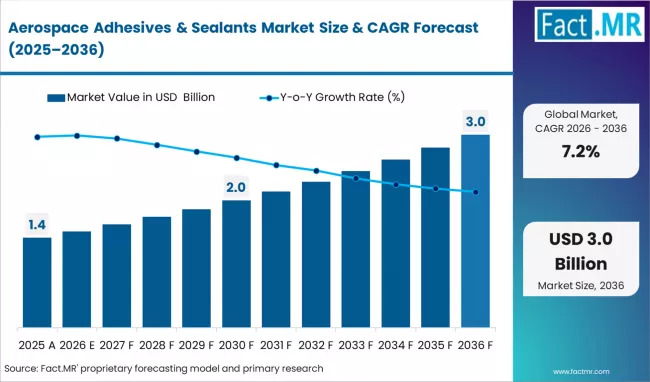
Aerospace Adhesives & Sealants Market to Surpass USD 3 Billion by 2036; Composite Adoption and MRO Ramps Drive 7.2% CAGR
ROCKVILLE, MD, UNITED STATES, April 8, 2026 /EINPresswire.com/ -- The global Aerospace Adhesives & Sealants Market is undergoing a structural transformation, valued at USD 1.40 billion in 2025 and projected to climb to USD 1.50 billion in 2026. According to the latest industry analysis, the market is set to reach USD 3.01 billion by 2036, expanding at a compound annual growth rate (CAGR) of 7.2%.For Details Deep insights, Please Request A sample report for Free: https://www.factmr.com/connectus/sample?flag=S&rep_id=11821
This growth is anchored by a fundamental shift in aerospace engineering: structural bonding is rapidly replacing traditional mechanical fastening in primary load paths. As OEMs (Original Equipment Manufacturers) ramp up production of composite-intensive aircraft, adhesives have evolved from auxiliary aids into mission-critical structural components.
Market Dynamics & Strategic Forecast
The move toward lightweighting is the primary catalyst for market expansion. Composite materials, which offer superior strength-to-weight ratios compared to aluminum, require advanced adhesive chemistries that can handle thermal cycling and chemical resistance without the stress concentrations caused by rivets.
Key Market Metrics (2026–2036):
Incremental Opportunity: USD 1.51 billion.
Lead Resin (Adhesives): Epoxy (41.0% share in 2026).
Lead Resin (Sealants): Silicone (40.0% share in 2026).
Dominant Segment: Commercial Aircraft (64.0% market share).
Segmental Analysis: Chemistry and Application
Adhesives: The Reign of Epoxy
Epoxy adhesives hold a commanding 41.0% share of the market. Their dominance is rooted in a proven qualification heritage and compatibility with carbon fiber substrates. Meanwhile, Polyurethane is emerging as the fastest-growing segment with a 7.4% CAGR, driven by its flexibility and rapid curing profiles ideal for cabin interiors and secondary structures.
Sealants: Integrity and Resistance
Silicone sealants lead the category (40.0% share), providing critical environmental protection and cabin pressurization. However, Polysulfide sealants remain the industry standard for fuel tank sealing due to their exceptional chemical resistance, maintaining a steady presence in both OEM and MRO (Maintenance, Repair, and Overhaul) sectors.
Aircraft Type: Commercial vs. Military
While Commercial Aircraft dominate by volume, the Military segment is the fastest-growing at a 7.5% CAGR. Defense modernization programs and the production of tactical fighter jets are pushing the boundaries of adhesive performance, requiring materials that survive extreme combat environments.
Regional Outlook: China and India Lead the Charge
The center of gravity for aerospace manufacturing is shifting toward the Asia-Pacific region.
China (7.5% CAGR): Leading global growth as domestic programs like the C919 reach full-rate production.
India (7.2% CAGR): Emerging as a global MRO hub, supported by government "Make in India" initiatives in defense and civil aviation.
United States (6.8% CAGR): Remains the largest regional market (USD 0.66 billion in 2025) due to the concentration of Boeing and Lockheed Martin facilities.
Europe: Germany (8% of EU market) and France (18.9%) continue to lead, leveraging deep ties with the Airbus supply chain.
Supply Chain & Competitive Landscape
The market is moderately consolidated, with leadership defined by "design authority approvals." Henkel AG & Co. KGaA currently leads the market with a 14.0% share, followed by global giants such as 3M, PPG Industries, and Huntsman.
The "Who Supplies Whom" Dynamics:
Tier 1 suppliers (like Spirit AeroSystems or GKN Aerospace) are increasingly entering long-term agreements with qualified chemical providers to ensure supply chain resilience. Procurement is no longer just about price; it is about specification compliance and technical data packages.
Expert Commentary
"We are seeing a narrowing competitive window for suppliers," says Shambhu Nath Jha, Principal Consultant at Fact.MR. "Procurement cycles are consolidating around those who can provide not just a chemical, but a validated 'bonding solution' that includes surface prep, curing protocols, and environmental compliance."
Future Outlook & Investment Risks
The industry's future is "Green and Automated." Key trends include:
Automation: Robotic dispensing is becoming a requirement for high-rate production lines to ensure precision and reduce waste.
Sustainability: Rapid development of low-VOC and chromate-free formulations to meet tightening REACH and environmental regulations.
Risks: Lengthy qualification cycles (often 3–5 years) act as a high barrier to entry, while fluctuating raw material costs for specialized resins can squeeze margins.
Executive Takeaways for Decision-Makers
Supply Chain: Secure long-term contracts now; specification windows for next-gen platforms are closing.
R&D: Prioritize bio-based and sustainable formulations to align with the "Net Zero 2050" aviation goals.
Operations: Invest in automated application equipment to handle the high-viscosity, high-performance resins required for composite bonding.
For instant access to this report, click “Buy Now” or connect with our analyst for customization: https://www.factmr.com/checkout/11821
To View Our Related Report:
Aerospace Composite Materials Using PCR Market: https://www.factmr.com/report/aerospace-composite-materials-using-pcr-market
Aerospace Robotic ScotchBlue Painting Tapes Market: https://www.factmr.com/report/aerospace-robotic-scotchblue-painting-tapes-market
Aerospace Plastics Industry: https://www.factmr.com/report/united-kingdom-aerospace-plastics-industry-analysis
Aerospace Plastics Market: https://www.factmr.com/report/4736/aerospace-plastic-market
S. N. Jha
Fact.MR
+1 628-251-1583
email us here
Legal Disclaimer:
EIN Presswire provides this news content "as is" without warranty of any kind. We do not accept any responsibility or liability for the accuracy, content, images, videos, licenses, completeness, legality, or reliability of the information contained in this article. If you have any complaints or copyright issues related to this article, kindly contact the author above.
