

Thin Film Solar Cell Market to Reach USD 39.5 Billion by 2035 at 7.5% CAGR.
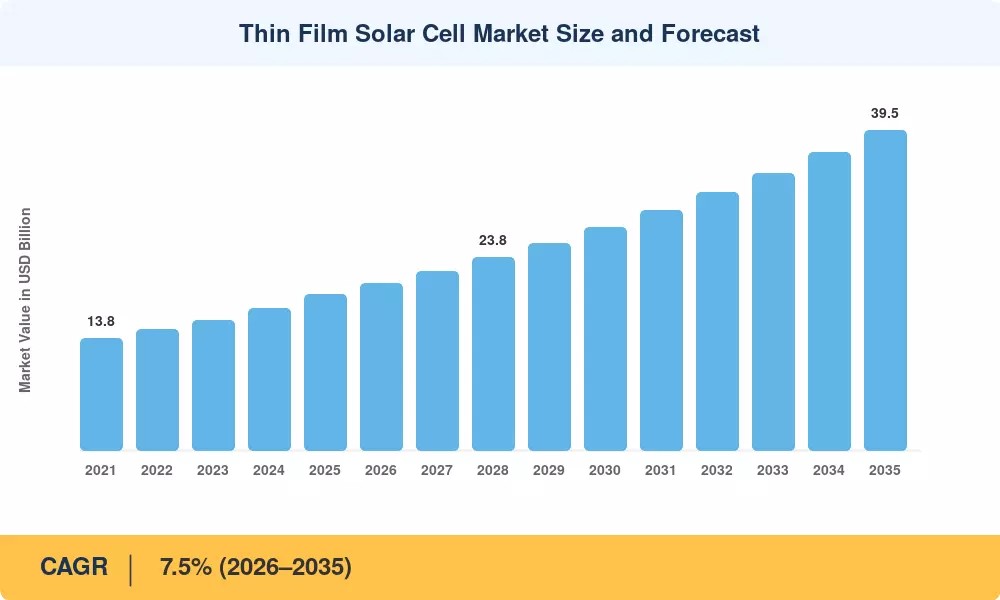
Thin film solar cell market share
CIGS technology is expanding at a CAGR of 9.3% through 2035, driven by growing demand for flexible substrates in commercial rooftop applications.
Emerging organic and perovskite-based thin film cells account for approximately USD 1.5 billion in 2025, with rapid R&D commercialization expected by 2028.”
NEW YORK, NY, UNITED STATES, July 29, 2026 /EINPresswire.com/ -- The global Thin Film Solar Cell Industry reached an estimated USD 19.2 billion in 2025 and is projected to grow from USD 20.6 billion in 2026 to USD 39.5 billion by 2035, registering a compound annual growth rate of 7.5% across the forecast period.— Prashant Hake
Market Overview
Thin film solar cell market represent a class of photovoltaic technologies that deposit one or more thin layers of photoactive material onto a substrate such as glass, plastic, or metal. Unlike conventional crystalline silicon panels that use thick wafers, thin film technologies—including cadmium telluride (CdTe), copper indium gallium selenide (CIGS), amorphous silicon (a-Si), and emerging perovskite-based designs—offer distinct advantages in lightweight flexibility, aesthetic integration, and superior performance in high-temperature and low-light conditions. These characteristics make thin film cells particularly suited for utility-scale ground-mounted systems, building-integrated photovoltaics (BIPV), commercial rooftops, off-grid rural electrification, and specialized applications such as vehicle integration and portable power.
The market's robust expansion is anchored in two powerful catalysts: the U.S. Inflation Reduction Act's extension of manufacturing tax credits through 2032, which has unlocked over USD 8 billion in domestic thin film production capacity commitments, and the European Union's revised Renewable Energy Directive targeting 42.5% renewable electricity by 2030. The International Energy Agency reports that global renewable capacity is projected to increase by 4,600 GW between 2025 and 2030, with solar PV accounting for approximately 80% of this growth, creating a massive and sustained demand tailwind for all solar technologies.
The technological environment within the thin-film solar cell market is drastically changing. CIGS panels, which have raised laboratory efficiencies beyond 23.6%, now pose a serious threat to CdTe modules that have long dominated the market due to their cost-per-watt advantage. The next commercial frontier for thin-film photovoltaics is perovskite-silicon tandem designs, which have surpassed 33% efficiency limits in laboratory conditions and are now entering early commercial production. Asia-Pacific holds approximately 45% of the market, driven by India's aggressive solar capacity ambitions under the PM-KUSUM plan and China's industrial dominance. With a CAGR of 9.1%, North America is the fastest-growing region thanks to utility-scale project pipelines and reshoring incentives, while Europe accounts for roughly 28% of global income due to BIPV mandates in Germany, France, and the Netherlands.
📍 Get Free Sample Report for Detailed Market Insights:
https://www.marketresearchfuture.com/sample_request/30600
Market Segmentation
The Thin Film Solar Cell Market is comprehensively segmented across technology, application, and connectivity categories to capture diverse industry dynamics and regional requirements.
By technology, CdTe commands roughly 52% of market revenue, reflecting First Solar's vertically integrated manufacturing scale and module cost leadership. Commercial CdTe modules are shipping at 18.8% to 19.7% efficiency in 2026, with the Series 7 platform securing multi-gigawatt supply agreements with U.S. utilities. CIGS technology is expanding at a CAGR of 9.3% through 2035, driven by efficiency gains and growing demand for flexible substrates in commercial rooftop applications where weight restrictions limit crystalline silicon deployment. Amorphous silicon accounts for approximately USD 2.9 billion in 2025, primarily serving consumer electronics and legacy installations, while emerging organic and perovskite-based thin film cells represent USD 1.5 billion with rapid R&D commercialization expected by 2028, as Oxford PV has commenced commercial production and shipment of perovskite-silicon tandem cells achieving module efficiencies between 24% and 27%.
By application, utility-scale solar farms represent the largest segment valued at approximately USD 9.2 billion in 2025, as CdTe modules deliver the lowest levelized cost of energy among all solar technologies for large ground-mounted installations in high-irradiance regions. Commercial and industrial applications account for USD 5.2 billion, driven by rooftop self-consumption and ESG procurement requirements. Residential installations are growing at 6.8% CAGR supported by declining system costs and net metering policies. Building-integrated photovoltaic installations are growing at the fastest rate of 11.2% CAGR, powered by European and Asian building energy codes mandating solar integration on new commercial structures, where thin film's lightweight and aesthetically versatile form factors provide unique advantages over traditional crystalline silicon panels. By connectivity, grid-connected installations capture roughly 82% of the market, while off-grid applications are growing at 10.8% CAGR, driven by rural electrification programs across Sub-Saharan Africa and South Asia.
🛒 You can buy this market report at:
https://www.marketresearchfuture.com/checkout?currency=one_user-USD&report_id=30600
Regional Analysis
Asia-Pacific holds a dominant 45% share of the Thin Film Solar Cell Market, led by Chinese CdTe and CIGS module production accounting for roughly 58% of regional revenue through vertically integrated manufacturing and domestic deployment targets. India is the fastest-growing country in the region at 11.2% CAGR, with the Production-Linked Incentive scheme allocating INR 24,000 crore to domestic solar manufacturing and several firms announcing thin-film production lines in Gujarat and Tamil Nadu. Japan contributes approximately USD 1.1 billion through rooftop mandates and limited utility-scale land availability, while Australia's exceptional irradiance conditions favor utility-scale CdTe deployments in Queensland and Western Australia.
North America is accelerating at 9.1% CAGR, the fastest among all regions, driven by IRA manufacturing credits, domestic content requirements, and utility procurement. The United States accounts for roughly 82% of regional revenue, with First Solar's Ohio, Alabama, and Louisiana gigafactories adding approximately 14 GW of annual CdTe production capacity by 2026. Canada's federal Clean Electricity Regulations mandate net-zero electricity grids by 2035, accelerating procurement of thin-film panels suited for northern latitudes where cold-weather performance advantages matter. Europe generates roughly USD 5.4 billion in 2025 revenue, anchored by aggressive decarbonization mandates and BIPV building codes. Germany leads with approximately 32% of European share through Energiewende acceleration and building energy acts requiring solar installations on new commercial buildings over 50 square meters of roof area, directly favoring lightweight thin-film solutions. France's 8.8% CAGR is driven by commercial rooftop mandates and nuclear diversification, while the Netherlands and Italy contribute through agricultural dual-use solar and South Mediterranean irradiance projects. The Middle East & Africa region represents the highest growth potential at 10.3% CAGR, with Saudi Arabia's National Renewable Energy Program targeting 58.7 GW of renewable capacity by 2030, where thin-film technologies' superior temperature coefficients deliver measurable yield advantages over crystalline silicon in extreme desert heat.
Competitive Landscape
The Thin Film Solar Cell Market exhibits moderate concentration with an estimated HHI of approximately 1,800–2,200, where the top five companies control roughly 55–60% of global revenue. First Solar dominates with approximately 28–32% market share through its vertically integrated Series 6 and Series 7 CdTe modules and utility-scale EPC services, leveraging a U.S.-centric manufacturing footprint. Hanwha Qcells holds 7–10% share with a diversified PV portfolio and perovskite tandem R&D. Solar Frontier (now integrated with Idemitsu) commands 5–7% share focusing on CIS modules for commercial rooftop applications in the Japanese market. Canadian Solar holds 4–6% share through global supply chains and bifacial thin film utility projects. MiaSolé Hi-Tech and Avancis (CNBM) each hold 3–5% share, specializing in flexible CIGS modules for lightweight applications and PowerMax CIGS facade modules for BIPV respectively. Oxford PV, a technology leader in perovskite-silicon tandem cells, holds 1–2% share with pre-commercial scale-up operations and early production shipments achieving module efficiencies between 24% and 27%. Sharp Solar and Ascent Solar hold smaller shares in premium efficiency space applications and flexible CIGS for military and consumer electronics.
Major companies are investing heavily in perovskite tandem commercialization, with Oxford PV leading the charge and First Solar acquiring certain intellectual property and talent in this space. Manufacturers are also expanding domestic production capacity under reshoring incentives, particularly in the United States where the IRA provides long-term tax credit visibility. Strategic partnerships between technology developers and established module manufacturers are accelerating the pathway from laboratory breakthroughs to commercial-scale production.
Latest Industry News & Developments
In November 2025, Ascent Solar Technologies and CisLunar Industries signed a teaming agreement to integrate Ascent's flexible thin-film photovoltaic technology with CisLunar's advanced power conversion systems for space applications. In 2026, Oxford PV officially commenced commercial production and shipment of its perovskite-silicon tandem solar cells, achieving module efficiencies between 24% and 27%, marking a significant milestone in commercializing next-generation photovoltaic technology. The Japanese government announced a USD 1.5 billion investment initiative dedicated to developing and scaling ultra-thin, flexible perovskite solar cells for diverse architectural and geographical surfaces, positioning Japan as a leader in next-generation thin-film technology.
Market Challenges & Opportunities
Commercial thin-film modules currently demonstrate efficiencies between 16% and 19%, trailing monocrystalline silicon that frequently exceeds 22% in mainstream production, posing challenges for space-constrained urban installations. CdTe modules contain cadmium, a heavy metal strictly regulated under the EU's RoHS Directive, and while solar panels currently benefit from specific use exemptions, regulatory scrutiny remains high and any future tightening would necessitate significant compliance investments. The production of CdTe and CIGS technologies relies on tellurium, indium, and gallium, which are vulnerable to supply chain concentration as China maintains dominant control over global gallium refining accounting for roughly 99% of primary production. Intense price competition from Chinese crystalline silicon overcapacity further pressures thin-film manufacturers to continuously reduce costs.
However, significant opportunities are emerging across multiple dimensions. Perovskite-silicon tandem commercialization represents the most transformative opportunity, with certified laboratory efficiencies exceeding 34.85% and commercial availability anticipated between 2028 and 2030, promising to redefine the market by integrating superior light-harvesting properties with established durability. Off-grid and distributed energy in emerging markets addresses the approximately 655 million people globally lacking electricity access, with the World Bank's USD 890 million financing package supporting millions of residential rooftop installations. Vehicle-integrated photovoltaics are transforming transport, with research indicating potential annual grid demand reductions reaching 15.6 TWh in Europe by 2030. Recycling and circular economy value creation under the EU's WEEE Directive mandating 85% collection rates and 80% recycling-by-weight is incentivizing advanced recycling facilities capable of recovering critical materials. Energy-as-a-service and leasing models are essential for overcoming high upfront capital barriers, expanding market access for businesses without requiring significant initial asset investment.
To explore more market insights, visit us at:
https://www.marketresearchfuture.com/reports/thin-film-solar-cell-market-30600
Final Market Summary
The Thin Film Solar Cell Market is positioned for robust growth, with projections indicating a near-doubling of market value from USD 19.2 billion in 2025 to USD 39.5 billion by 2035, at a CAGR of 7.5%. This expansion is underpinned by aggressive renewable energy mandates, manufacturing tax credits and reshoring incentives, continuous efficiency gains in CdTe and CIGS technologies, and the accelerating commercialization of perovskite-silicon tandem architectures. While challenges including lower module efficiency compared to monocrystalline silicon, cadmium toxicity concerns, critical mineral supply constraints, and intense price competition persist, emerging opportunities in tandem commercialization, off-grid electrification, vehicle integration, and recycling infrastructure offer significant potential for industry participants. The future market landscape will be defined by companies that successfully commercialize next-generation technologies, scale domestic manufacturing capacity, navigate evolving regulatory requirements, and establish circular economy capabilities, with North America set for the fastest growth through reshoring incentives while Asia-Pacific maintains its manufacturing dominance.
More Related Reports from MRFR Library:
Turboexpander Market: https://www.marketresearchfuture.com/reports/turboexpander-market-6458
Floating Solar Panels Market: https://www.marketresearchfuture.com/reports/floating-solar-panels-market-6564
Turbocompressor Market: https://www.marketresearchfuture.com/reports/turbocompressor-market-6610
Gas Insulated Transformer Market: https://www.marketresearchfuture.com/reports/gas-insulated-transformer-market-6611
Flow Battery Market: https://www.marketresearchfuture.com/reports/flow-battery-market-6620
Variable Speed Generator Market: https://www.marketresearchfuture.com/reports/variable-speed-generator-market-6658
Scrubber System Market: https://www.marketresearchfuture.com/reports/scrubber-system-market-6660
Robotic Drilling Market: https://www.marketresearchfuture.com/reports/robotic-drilling-market-6661
Turbine Control System Market: https://www.marketresearchfuture.com/reports/turbine-control-systems-market-6675
Solar Thermal Collectors Market: https://www.marketresearchfuture.com/reports/solar-thermal-collectors-market-6687
Larry Wilson
WantStats Research And Media Pvt. Ltd.
+ +1 855-661-4441
email us here
Visit us on social media:
LinkedIn
Facebook
YouTube
X
Legal Disclaimer:
EIN Presswire provides this news content "as is" without warranty of any kind. We do not accept any responsibility or liability for the accuracy, content, images, videos, licenses, completeness, legality, or reliability of the information contained in this article. If you have any complaints or copyright issues related to this article, kindly contact the author above.
