
Zero Liquid Discharge Market to Reach USD 20.79 Billion by 2035 at 8.5% CAGR.
Zero Liquid Discharge market share
Membrane-based ZLD technologies are growing at a CAGR of 11.3%, driven by energy-efficiency gains and falling membrane costs.
Hybrid systems combining membrane pre-concentration with thermal polishing generated approximately USD 1.38 billion in 2025.”
NEW YORK, NY, UNITED STATES, July 29, 2026 /EINPresswire.com/ -- — Prashant Hake
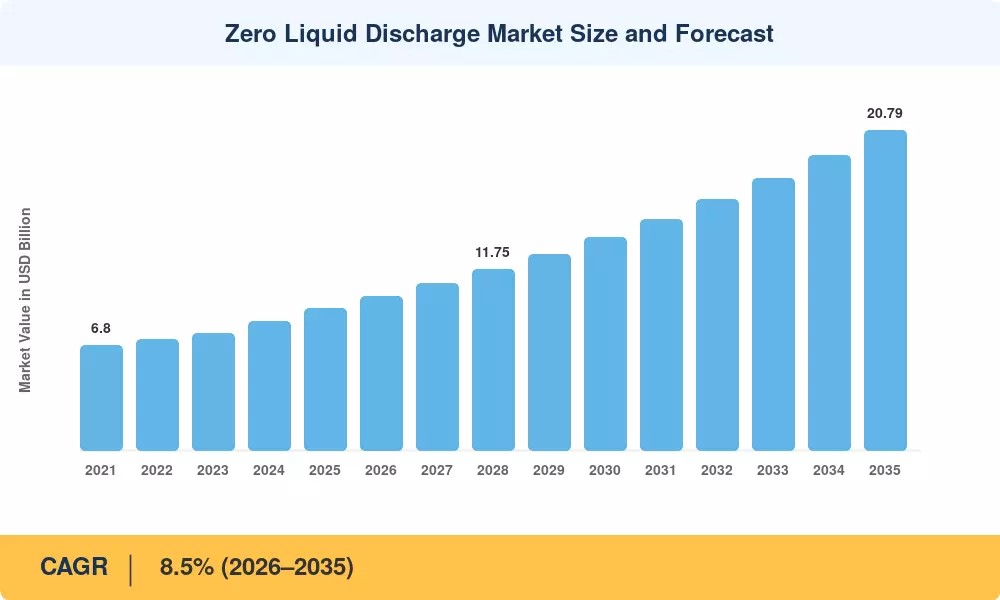
The Zero Liquid Discharge Market reached an estimated USD 9.20 billion in 2025 and is projected to grow from USD 9.98 billion in 2026 to USD 20.79 billion by 2035, registering a CAGR of 8.5% during the forecast period (2026–2035).
Market Overview
Zero Liquid Discharge (ZLD) refers to an advanced wastewater treatment strategy designed to eliminate all liquid discharge from industrial facilities, recovering up to 99% of water for reuse while converting dissolved solids into dry, handleable salts or brines. ZLD systems employ a combination of membrane-based pre-concentration technologies such as reverse osmosis and nanofiltration, followed by thermal processes including evaporators, crystallizers, and sometimes spray dryers to achieve maximum water recovery. This approach addresses both regulatory compliance and water conservation, particularly critical in water-stressed regions where industrial operations face tightening discharge limits and growing freshwater costs.
The market's robust expansion is anchored in tightening effluent discharge regulations across developed and developing economies. The U.S. EPA's 2024 revisions to the Effluent Limitations Guidelines for the Steam Electric Power Generating category, which impose stricter limits on flue gas desulfurization wastewater, have pushed utilities toward full-scale ZLD adoption. Concurrently, China's 14th Five-Year Plan earmarked over USD 12 billion for industrial water recycling infrastructure, creating a significant demand corridor for ZLD systems across coal-fired power plants and chemical parks. The World Resources Institute estimates that 25 countries face extremely high baseline water stress, a figure projected to rise by 40% by 2040, making ZLD a strategic necessity rather than merely a compliance burden.
The technology landscape within the Zero Liquid Discharge Market is undergoing significant transformation. Traditional thermal-only treatment trains using brine concentrators and forced-circulation crystallizers are being replaced by hybrid architectures combining high-recovery reverse osmosis with smaller thermal back-ends, reducing energy usage by 40–60% per cubic meter of treated effluent. This change makes ZLD economically viable for mid-sized plants that previously relied on conventional evaporation ponds. Membrane distillation and forward osmosis pilot efforts, supported through a USD 45 million DOE Water Security Grand Challenge, are accelerating the shift toward more energy-efficient solutions. As water scarcity intensifies globally, the market is expected to continue growing at double-digit rates across various industrial verticals through 2035.
Get Free Sample Report for Detailed Market Insights:
https://www.marketresearchfuture.com/sample_request/29460
Market Segmentation
The Zero Liquid Discharge Market is comprehensively segmented across technology, end-use industry, and geography to capture diverse application requirements and regional dynamics. By technology, thermal-based systems (evaporators and crystallizers) account for approximately 55% of the market, benefiting from proven reliability in high-salinity applications where wastewater TDS exceeds 70,000 mg/L. Membrane-based ZLD technologies are growing at a CAGR of 11.3%, driven by energy-efficiency gains and falling membrane costs, with high-pressure reverse osmosis systems achieving 92–95% recovery rates. Hybrid systems combining membrane pre-concentration with thermal polishing generated approximately USD 1.38 billion in 2025, offering the optimal cost-energy balance that reduces total energy consumption by approximately 50% compared to purely thermal trains, expanding the addressable market beyond power and petrochemicals.
By end-use industry, power generation represents the dominant sector with a 28% share, largely driven by coal-plant wastewater compliance mandates under the U.S. EPA's ELG revisions, affecting more than 100 coal-fired units with a combined compliance investment estimated at USD 3.5 billion. Chemical and petrochemical facilities collectively contributed USD 2.02 billion in 2025 revenue, driven by process water reuse requirements and EU Industrial Emissions Directive compliance. The textile industry is the fastest-growing end-use vertical at a CAGR of 10.8%, led by India's Common Effluent Treatment Plant mandates following the National Green Tribunal's 2023 directive for ZLD compliance in Tamil Nadu and Gujarat dyeing clusters, which catalyzed over 40 new system installations valued between USD 5 million and USD 25 million each. Pharmaceutical applications are growing at 9.6% CAGR due to API manufacturing discharge rules, while oil and gas applications generated USD 0.74 billion in 2025 for produced water and tailings treatment. Food and beverage, semiconductor, mining, and pulp and paper represent additional growing segments.
You can buy this market report at:
https://www.marketresearchfuture.com/checkout?currency=one_user-USD&report_id=29460
Regional Analysis
North America holds the largest share of the Zero Liquid Discharge Market, accounting for approximately 32% of 2025 revenue, driven by strict regulations in the power industry and compliance schedules for aging coal plants. The United States dominates with 78% of regional share, with coal-fired power plant compliance under the EPA's 2024 ELG rule revisions driving the largest single demand block. Canada's oil sands region presents a distinct growth pocket, as Alberta's Tailings Management Framework requires operators to demonstrate progressive reclamation using advanced water treatment technologies.
Asia-Pacific is the fastest-growing region with a projected CAGR of 10.2%, driven by requirements from India's Central Pollution Control Board and the proliferation of zero-discharge industrial parks in China. China accounts for 38% of regional share, with the Ministry of Ecology and Environment designating over 60 zero-discharge industrial parks since 2020, creating a concentrated procurement pipeline. India is growing at an impressive 11.5% CAGR, with National Green Tribunal enforcement actions against non-compliant textile clusters generating immediate demand, with industry estimates suggesting a 40% increase in ZLD installations across Indian dyeing units between 2023 and 2025. Japan and South Korea contribute through semiconductor fabrication water reuse and steel sector compliance respectively.
Europe follows with approximately 24% share, driven by revisions in the pharmaceutical and chemical sectors under the EU Industrial Emissions Directive. Germany leads with 26% of regional share through chemical sector compliance, while the UK is the fastest-growing European market with NHS supply chain requirements pushing pharmaceutical manufacturers toward closed-loop water systems. The Middle East & Africa region, valued at USD 0.92 billion in 2025, is driven by Saudi Arabia's NEOM industrial zone specifying ZLD as mandatory for all manufacturing facilities, creating a single-project pipeline worth an estimated USD 800 million in equipment procurement, and desalination brine management requirements. South America, growing at 9.1% CAGR, is gaining momentum as mining operations in the lithium triangle and copper belt face increasingly stringent water use regulations, with Chile's Superintendency of the Environment levying record fines against mining operators in 2024 for unauthorized brine discharge.
Competitive Landscape
The Zero Liquid Discharge Market is moderately consolidated, with the top five competitors accounting for an estimated 35-42% market share and a Herfindahl-Hirschman Index between 600 and 800, indicating considerable fragmentation with a number of mid-tier specialists competing with large, diversified water treatment conglomerates. Competition is based on differentiation of technology, geographic reach, and capacity to provide comprehensive EPC solutions rather than components only.
Veolia Water Technologies holds 8–12% market share through HPD evaporation/crystallization and hybrid ZLD systems, positioning as a full-service global EPC leader. Aquatech International commands 7–10% with thermal and membrane ZLD systems, specializing in mid-market industrial applications. SUEZ Water Technologies holds 6–9% through evaporators and integrated ZLD solutions within a diversified water utility portfolio. IDE Technologies captures 5–7% with membrane-based ZLD and desalination expertise, focusing on high-recovery membrane innovation. Thermax Limited holds 4–6% through thermal ZLD and chemical treatment solutions, serving as a regional leader in India and Asia-Pacific. Praj Industries holds 3–5% with evaporators and ZLD for pharma and textile applications, while Saltworks Technologies, Oasys Water (now Battelle), H2O Innovation, and Doosan Enerbility represent emerging and specialized players.
Key players are investing heavily in hybrid system architectures, digital twin platforms, and AI-driven optimization to differentiate their offerings and reduce total cost of ownership for end-users. In October 2024, IDE Technologies unveiled a high-recovery RO system achieving 97% recovery rates in pilot testing, reducing downstream thermal load by 85% and positioning it as a breakthrough for the market.
Latest Industry News & Developments
In October 2024, IDE Technologies unveiled a high-recovery RO system achieving 97% recovery rates in pilot testing, reducing downstream thermal load by 85% and positioning it as a breakthrough for the Zero Liquid Discharge Market. In April 2024, the U.S. EPA finalized the Effluent Limitations Guidelines for steam electric power generating facilities, establishing binding ZLD compliance deadlines affecting over 100 U.S. power plants. In October 2024, Veolia Water Technologies announced a strategic partnership with a leading Indian textile manufacturer to deploy a hybrid ZLD system for a major dyeing cluster in Tamil Nadu, reflecting the accelerating adoption in Asia-Pacific's fastest-growing end-use segment.
Market Challenges & Opportunities
High capital and operating costs represent the most significant challenge, as a full-scale ZLD system for a 500 m³/hr wastewater flow typically requires capital expenditure of USD 50–100 million, with annual operating costs running 3–5 times those of conventional treatment alternatives. The levelized cost of ZLD-treated water ranges from USD 8 to USD 15 per cubic meter, compared with USD 1–3 for conventional activated sludge systems. Energy consumption challenges persist, as thermal ZLD systems consume 20–30 kWh per cubic meter of feed water, placing them among the most energy-intensive industrial water processes, with energy alone accounting for 60–70% of total operating expenditure in regions where electricity costs exceed USD 0.12/kWh. Skilled workforce shortages, with a 2024 International Desalination Association survey finding that 38% of ZLD plant operators in Asia-Pacific reported staffing gaps as their top operational challenge, further constrain market growth.
However, significant opportunities are emerging across multiple dimensions. Emerging market industrialization in Southeast Asia, Sub-Saharan Africa, and Latin America is creating new opportunities, with Vietnam's textile sector under increasing environmental pressure and Indonesia's nickel processing expansion driving interest in ZLD configurations. Water-as-a-Service business models that shift from capital-intensive ownership to operational expenditure models are helping mid-sized chemical and pharmaceutical companies bypass traditional budgetary hurdles, enabling compliance through specialized providers. Mineral recovery and circular economy value from advanced crystallizer systems, through selective recovery of high-value commodities such as lithium, sodium sulfate, and potassium chloride from brine streams, can create secondary revenue streams. Digital twin and predictive maintenance integration leveraging AI-driven platforms is reducing chemical dosing costs by 20–30% and extending equipment lifespan by 15–25%, fostering a new "digital water" sub-sector. Solar-thermal and waste-heat ZLD integration is addressing energy intensity by pairing installations with concentrated solar power or industrial waste-heat recovery, particularly viable in high-insolation industrial zones such as the Middle East and parts of India.
To explore more market insights, visit us at:
https://www.marketresearchfuture.com/reports/zero-liquid-discharge-market-29460
Final Market Summary
The Zero Liquid Discharge Market is positioned for robust growth, with projections indicating more than a doubling of market value from USD 9.20 billion in 2025 to USD 20.79 billion by 2035, at a CAGR of 8.5%. This expansion is underpinned by tightening effluent discharge regulations, intensifying freshwater scarcity, corporate ESG and water stewardship mandates, and the rapid industrialization of emerging economies. While challenges including high capital and operating costs, energy intensity, and skilled workforce shortages persist, emerging opportunities in hybrid system architectures, water-as-a-service models, mineral recovery, digital twin optimization, and renewable energy integration offer significant potential for industry participants. The future market landscape will be defined by companies that successfully reduce total cost of ownership through technology innovation, expand into high-growth emerging markets, and develop circular economy capabilities that transform wastewater treatment from a compliance cost into a value-generating operation, with Asia-Pacific set to dominate global growth through textile sector mandates and coal-power ZLD requirements, while North America sustains demand through power sector compliance.
More Related Reports from MRFR Library:
Heat Meter Market: https://www.marketresearchfuture.com/reports/heat-meter-market-6979
Digital Fault Recorder Market: https://www.marketresearchfuture.com/reports/digital-fault-recorder-market-6986
Permanent Magnet Motor Market: https://www.marketresearchfuture.com/reports/permanent-magnet-motor-market-6991
CNG Dispenser Market: https://www.marketresearchfuture.com/reports/cng-dispenser-market-7001
Electric Traction Motor Market: https://www.marketresearchfuture.com/reports/electric-traction-motor-market-7002
Offshore Energy Storage Market: https://www.marketresearchfuture.com/reports/offshore-energy-storage-market-7010
Gas Insulated Substation Market: https://www.marketresearchfuture.com/reports/gas-insulated-substation-market-7011
Traction Transformer Market: https://www.marketresearchfuture.com/reports/traction-transformer-market-7024
Industrial Control Transformer Market: https://www.marketresearchfuture.com/reports/industrial-control-transformer-market-7025
Hydrogen Generation Market: https://www.marketresearchfuture.com/reports/hydrogen-generation-market-7026
Larry Wilson
WantStats Research And Media Pvt. Ltd.
+ +1 855-661-4441
email us here
Visit us on social media:
LinkedIn
Facebook
YouTube
X
Legal Disclaimer:
EIN Presswire provides this news content "as is" without warranty of any kind. We do not accept any responsibility or liability for the accuracy, content, images, videos, licenses, completeness, legality, or reliability of the information contained in this article. If you have any complaints or copyright issues related to this article, kindly contact the author above.
